Monday, 7 March 2022

Role Play

 Roll on to the role play

What does our problem look like?

To further break down our problem we dusted off those acting skills again and took up roles to show how the problem affected the stakeholders identified.

I got to work with Pip who was focusing on providing higher order skills and questions to her students. I played Nick a typical disillusioned teen with the weight of the world on my shoulders, subtly implying a lack of direction from home through facial ticks and ...no I was just Nick the student. We looked at simple and higher order thinking through questioning. Pip asked simple questions which I was able to answer then responded with shoulder shrugs when things got deeper.

In my role-play we looked at my problem from 2 perspectives. Lock down and how the caregiver would support and engage with the learning and out of lock down where the caregiver was too busy or had other things they were doing that they valued more.

The activity showed that through parody I could identify my perceptions. Whether or not they are reality is still to be proved but the team agreed that this was also what they perceived about the issues we identified.


We had to consider why our problem was a problem and how other stakeholders feel, act and may perceive things.


 

Sunday, 6 March 2022

Academy Awards - Role Play

 And the Oscar goes to

Our first foray into the process of unpacking our ideas onsite was also a great ice breaker.

Our initial identified problems were put on show at a parent meeting with the premise that these things were going to be taken to the ministry and how do 'we, as parents' feel about them.

We had Jenny sitting in as the school principal and Dorothy was our board chair. The rest of the team were parents from different walks of life. I drew the successful artist with a loose look at the way a school should be run. We had farming parents, lawyers, grandparents ex lecturers, plumbers, among other things.

Each problem came up on the screen and vigorous discussion ensued.


Free image pixabay

The process was a great way to unpack problems form a range of perspectives

It identified shortcomings in our initial proposals and gave ideas on honing them in.

It allowed us to consider where we were pointing fingers when coming up with problems and the perspective of blame.

It did paint a picture of a worrying trend in the school with many problems coming from a range of sources.

and... importantly it was fun with no judgement, just discussion.


The next step was taking this discussion and the ideas generated and clarify our own problem. I must have changed my initial problem's wording 10 times before finalising my idea, maybe.

  • Whanau rarely engage with online or ubiquitous learning.

Why, why, why, why, why = wise

 Tell me why

Following the Moonshot Proposal we were paired up. We were tasked with connecting with a fellow MITer and ask why!
This is designed to challenge the problem identified and dig deeper into it. It provides a fresh set of eyes and ideas and opens discussion targeted at the identified problem.

I was teamed up with Jono and his problem involving Maths at Year 7/8 level and Deb came on board to help me dissect my problem around whanau engagement online.

The process was nice and simple yet proved engaging and enjoyable, if challenging when thinking of whys.
  • Read through your buddies proposal
  • Focus on the problem and ask 1 why question
  • Wait for response then ask another why question based on this response
  • Wait for response then ask another why question based on this response
  • Wait for response then ask another why question based on this response
  • etc


 It was a positive way to connect with another member of the team and a start in the getting to know you part of collaborating. It built trust and a relationship in a meaningful way while challenging each others thinking.


New Moon - The Moonshot Proposal


The task: Identify a challenge impacting students in our class or at our school
  • I had been concerned with the lack of commenting on blogs.
It was evident the children who were getting a buy in from home were performing better academically and those who had had no responses were not invested in blogging. Their posts were rudimentary at best and they were reluctant to take time to produce quality posts.


I considered this and considered ways to improve this engagement from home. Eventually I came up with the initial problem of...

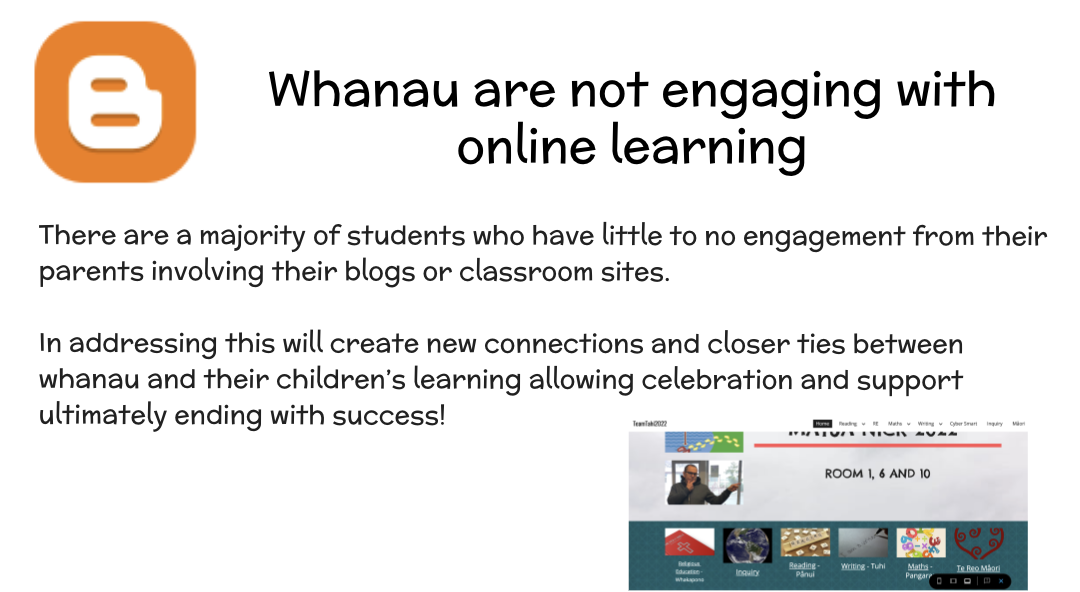
  • Whanau are not engaging with online learning


This was broader and I felt it was a good place to start.
I took this problem and continued through the Moonshot process.


I had to identify who it is a problem for and how do I know it's a problem. Looking further afield I found information that supported my thoughts on the impact of social media at home.

The next step was to come up with some initial proposals and ideas that may help improve outcomes and address the problem I had identified.

The initial stage of the moonshot proposal ended with considering how technology could impact my problem in a positive way.


The Moonshot proposal process was a great way to identify my initial ideas. I am sure they will be extended and challenged through the year working with MIT. I am confident and excited to see where the inquiry takes me!


MIT - assemble

Thursday ended early for me as I had to hightail it to the airport to begin the journey to Kuaotuna in the Coromandel.

I was the only traveller from the South Island and was looking forward to the adventure up north. It felt like a huge privilege to be included in the team and the rich history of the previous participants and their innovations.

I managed to get to Kuaotuna in time for tea. The venue was amazing and the Manaiakalani team of Jenny, Dorothy and Matt made everyone feel welcome. 
It turned out we were missing a couple of members of our MIT team onsite but the valuable discussion and thinking was present the whole 3 days. (as was the beautiful beach and incredible night sky!)

The Kuaotuna team!

I left the team for the trek back home with a full mind and excitement to see where the inquiry would take me and the team. 
Soaring above the clouds


Monday, 19 August 2019

Check sheet - What I've learnt

Check sheet - What I've learnt 

Notes for me - maybe indecipherable for others
(Maybe) (Probably) (More than likely)


Find average - select square - sigma - average - highlight - drag down to highlight column 
When sorting - make sure you have correct order

 Highlight rows to lock and click filter


- click columns - sort

Click on the chart -


Ensure data to chart is selected
Make two different.
Clicking on the three dots at the top right corner - select move to own sheet.

Sites

sites.google.com

click the + (the big rainbow one dummy)


After DFI 1

The Saga continues

It has been half a term since I completed my DFI experience. Luckily I am blessed with the ability to review and reinvigorate by reading Bernards blog as he goes through the process. (I would like to see Angela's and Nicole's as well but no link is forthcoming.)

Bernards latest post has reminded me of the benefit of recording your thoughts, maybe for yourself only.

He had a peer suggest this site to engage learners and follow instructions as a step into coding.
http://compute-it.toxicode.fr/


The sharing of this from a peer to a colleague to a blog to a colleague... shows that new ideas exist and they should be to benefit learners across the world.

This week I have had children contact the library and organise a class visit. We have blogged up a storm and have had a closer look at our rubric and discussed ways to record and judge. We have had leaders teach others a new game outside - tuakana teina and I have used feedback on my writing lesson to adapt my delivery.

Well not much of a post - more for myself. Hope I can start a habit (blogging that is)

Nga Mihi
N.G.

  Korea – Day one   After a challenging overnignt flight I touched down at Incheon Airport. A cruise through customs and then I met Philip, ...